
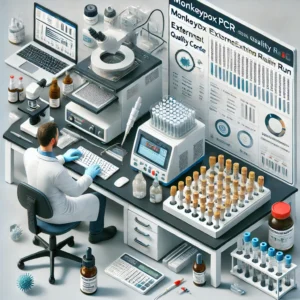
External Quality Control (EQC) is a critical component in the laboratory diagnosis of infectious diseases, including Monkeypox. The Monkeypox PCR External Run External Quality Control kits are designed to assess the accuracy and reliability of PCR (Polymerase Chain Reaction) assays used to detect Monkeypox virus DNA. These controls ensure that PCR tests produce consistent and reliable results across different laboratories and over time, helping to maintain diagnostic accuracy and prevent false negatives or positives.
What is Monkeypox?
Monkeypox is a viral zoonotic disease caused by the Monkeypox virus, which belongs to the Orthopoxvirus genus. It shares similarities with smallpox but is generally less severe. The virus can spread from animals to humans and also between humans, causing symptoms such as fever, rash, and swollen lymph nodes. The early and accurate diagnosis of Monkeypox is essential for effective disease management and control. More detailed information on Monkeypox can be found at CDC and WHO.
Importance of External Quality Control in PCR Testing
External Quality Control (EQC) refers to the use of external materials to verify the performance of PCR assays. These controls are processed alongside patient samples to ensure that the PCR test system is functioning correctly. For Monkeypox, the EQC ensures that laboratories can accurately detect the virus and reduces the likelihood of diagnostic errors. Guidelines on the importance of quality control can be found at NIH and FDA.
Features of Monkeypox PCR External Run External Quality Control
- Accuracy Verification: The EQC ensures that the PCR assay can reliably detect Monkeypox virus DNA, minimizing the risk of false results. For more on assay accuracy, refer to ISO.
- Consistency Across Laboratories: By using standardized external controls, results can be compared across different laboratories, ensuring that diagnostic protocols are consistent. Additional information can be found at WHO.
- Ease of Integration: These controls are designed to integrate seamlessly into existing PCR workflows, allowing for easy and routine performance verification. More on integrating EQC in diagnostic labs is available at NIST.

Applications of Monkeypox PCR External Run External Quality Control
- Routine Diagnostic Testing: EQC kits are used to validate the accuracy of diagnostic PCR tests for Monkeypox. This is essential for laboratories conducting routine testing to ensure reliable results. For more information on diagnostic testing, visit CDC.
- Research and Development: In addition to diagnostics, these quality control kits are used in research settings to validate new testing protocols and evaluate the sensitivity and specificity of novel PCR assays. Explore R&D guidelines at NIH.
- Inter-laboratory Comparisons: EQC kits facilitate proficiency testing by enabling laboratories to participate in external quality assessment (EQA) schemes, which assess lab performance against standardized benchmarks. Learn more about EQA at WHO.
How the Monkeypox PCR External Run EQC Works
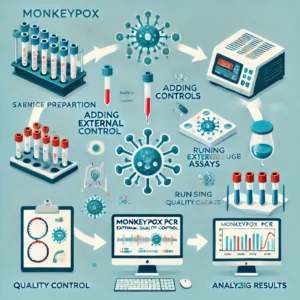
- Preparation: The EQC kit includes a positive control containing Monkeypox virus DNA, a negative control, and possibly an internal control to verify the assay process.
- Running the PCR Assay: These controls are run alongside patient samples to assess the PCR assay’s accuracy and performance. The controls should produce expected results—positive for the positive control, negative for the negative control.
- Verification: If the controls produce the expected results, the PCR assay is confirmed to be functioning correctly. Any deviation indicates potential issues, prompting further investigation. Detailed protocols are available at FDA.
Advantages of Using External Run External Quality Control Kits
- Improved Diagnostic Confidence: EQC kits provide assurance that PCR assays for Monkeypox are accurate and reliable, enhancing diagnostic confidence. More on improving diagnostic reliability can be found at NIH.
- Standardization: These controls help standardize testing procedures across different laboratories, ensuring consistent diagnostic performance. Explore standardization protocols at ISO.
- Compliance with Regulatory Requirements: Regular use of EQC kits ensures compliance with regulatory guidelines for clinical diagnostics, which often require routine quality checks. Information on regulatory compliance can be accessed through FDA.
Challenges and Considerations
While EQC kits play a vital role in PCR testing, challenges such as maintaining the integrity of control samples, proper storage, and handling can affect their performance. Laboratories must follow strict protocols for handling and storing EQC materials to prevent degradation. For best practices, refer to guidelines by CDC and WHO.
Future Directions in Quality Control for Infectious Disease Testing
Advancements in quality control for PCR testing aim to improve the sensitivity and robustness of assays, particularly for emerging infectious diseases like Monkeypox. Future developments may include multi-pathogen control kits that can be used across different viral assays, improving efficiency and reducing costs. Stay updated with research at Harvard and MIT.
Conclusion
Monkeypox PCR External Run External Quality Control kits are essential for maintaining the accuracy and reliability of diagnostic testing for Monkeypox. These controls ensure that PCR assays are performing correctly, which is crucial for diagnosing and managing infectious diseases. For more information on the role of quality control in diagnostics, explore resources at CDC, WHO, and NIH.
The use of EQC kits contributes significantly to the standardization of diagnostic protocols, ensuring that results are consistent and accurate across laboratories, ultimately leading to better disease management and control.